
Everyone Is Saying There Have Been “18 School Shootings This Year.” That’s A Lie.
More Gun Laws Won’t Prevent Unspeakable Tragedies
February 15, 2018Megyn Kelly Delivers Monologue About Shooting, And I Have Some Stuff To Say About That…
February 15, 2018I’ve seen this everywhere today… “18 SCHOOL SHOOTINGS SO FAR THIS YEAR! AND WE’RE ONLY HALF WAY THROUGH FEBRUARY!”

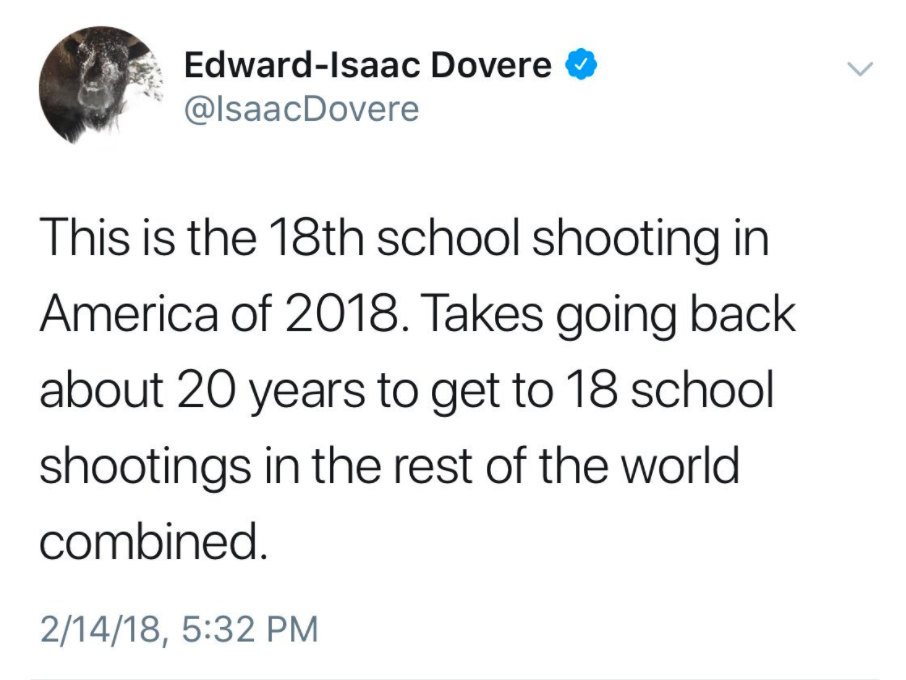
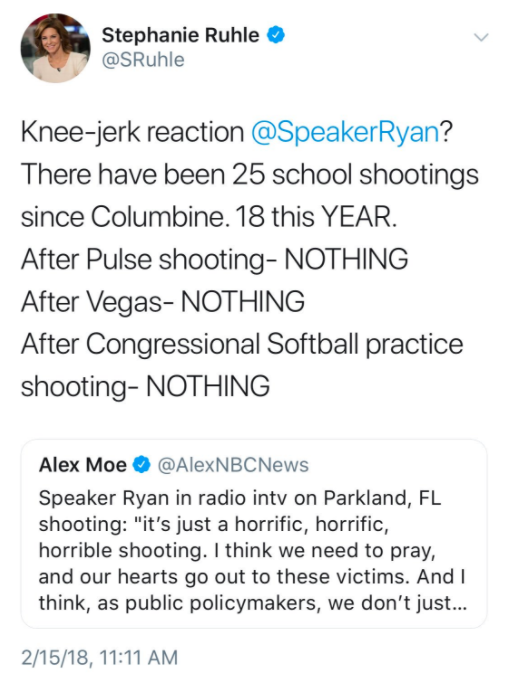


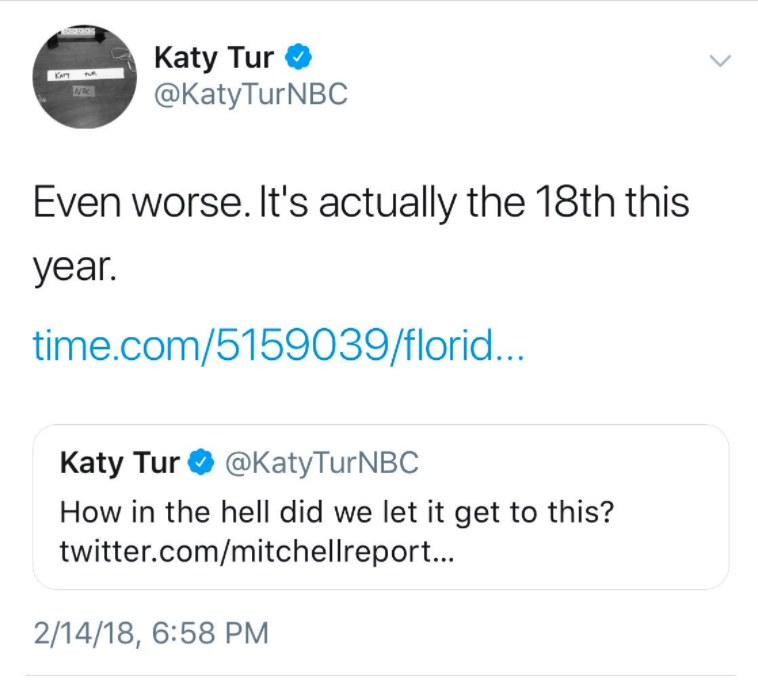
I’ve made my point, right?
Listen… I hate school shootings as much as anybody. This is truly a heinous, despicable act. My heart breaks with the rest of America’s.
BUT.
We need to set the record straight here… because false information does little to solve the problem.
There have NOT been 18 “school shootings” this year. This number is misinformed if not maliciously misleading.
According to the Washington Post:
The stunning number swept across the Internet within minutes of the news Wednesday that, yet again, another young man with another semi-automatic rifle had rampaged through a school, this time at Marjory Stoneman Douglas High in South Florida.
The figure originated with Everytown for Gun Safety, a nonprofit, co-founded by Michael Bloomberg, that works to prevent gun violence and is most famous for its running tally of school shootings.
“This,” the organization tweeted at 4:22 p.m., “is the 18th school shooting in the U.S. in 2018.”
Sen. Bernie Sanders’s tweet including the claim has been liked more than 45,000 times, and one from political analyst Jeff Greenfield has cracked 116,000. New York City Mayor Bill de Blasio tweeted it, too, as did musicians Cher and Alexander William and actors Misha Collins and Albert Brooks. News organizations — including MSNBC, ABC News, NBC News, CBS News, TIME, MSN, the BBC, the New York Daily News and the Huffington Post — also used the number in their coverage. By Wednesday night, the top suggested search after typing “18” into Google was “18 school shootings in 2018.”
It is a horrifying statistic. And it is wrong.
No ifs, ands, or buts here. It’s wrong.
Everytown has long inflated its total by including incidents of gunfire that are not really school shootings. Take, for example, what it counts as the year’s first: On the afternoon of Jan. 3, a 31-year-old man who had parked outside a Michigan elementary school called police to say he was armed and suicidal. Several hours later, he killed himself. The school, however, had been closed for seven months. There were no teachers. There were no students.
Also listed on the organization’s site is an incident from Jan. 20, when — at 1 a.m. — a man was shot at a sorority event on the campus of Wake Forest University. A week later, as a basketball game was being played at a Michigan high school, someone fired several rounds from a gun in the parking lot. No one was injured, and it was past 8 p.m., well after classes had ended for the day, but Everytown still labeled it a school shooting.
Everytown explains on its website that it defines a school shooting as “any time a firearm discharges a live round inside a school building or on a school campus or grounds.”
Does a man killing himself in the parking lot of a closed down school count as a “School shooting” to you?
Everytown stands by their number.
Sarah Tofte, Everytown’s research director, calls the definition “crystal clear,” noting that “every time a gun is discharged on school grounds it shatters the sense of safety” for students, parents and the community.
She said she and her colleagues work to reiterate those parameters in their public messaging. But the organization’s tweets and Facebook posts almost never include that nuance. Just once in 2018, on Feb. 2, has the organization clearly explained its definition on Twitter. And Everytown rarely pushes its jarring totals on social media immediately after the more questionable shootings, as it does with those that are high-profile and undeniable, such as the Florida massacre or one from last month in Kentucky that left two students dead and at least 18 people injured.
After The Post published its story, an Everytown spokeswoman said that the site planned to remove the Jan. 3 suicide outside the closed Michigan school.
So why is this so important? Because as the article states “gun-control activists use them as evidence in their fight for bans on assault weapons, stricter background checks and other legislation.”
If we’re going to have these kinds of conversations – they HAVE to be based on facts.
Not ONE of the people I’ve seen sharing the statistic on Facebook today have any CLUE how nuanced- and false – that number really is.
Just five of Everytown’s 18 school shootings listed for 2018 happened during school hours and resulted in any physical injury. Another three appeared to be intentional shootings but didn’t hurt anyone. Two more involved guns — one carried by a school police officer and the other by a licensed peace officer who ran a college club — that were unintentionally fired and, again, led to no injuries. At least seven of Everytown’s 18 shootings took place outside normal school hours.
Shootings of any kind, of course, can be traumatic, regardless of whether they cause physical harm.
A month ago, for example, a group of college students were in a criminal justice club in Texas when a student accidentally fired a real gun, rather than a training weapon. The bullet went through a wall, then a window. Though no one was hurt, it left the student distraught.
Is that a school shooting, though? Yes, says Everytown.
“Since 2013,” the organization proclaims on its site, “there have been nearly 300 school shootings in America — an average of about one a week.”
But since Everytown began its tracking, it has included dubious examples: In August 2013, a man shot on a Tennessee high school’s property at 2 a.m.; in December 2014, a man shot in his car late one night and discovered the next day in a Pennsylvania elementary school parking lot; in August 2015, a man who climbed atop the roof of an empty Texas school on a Sunday morning and fired sporadically; in January 2016, a man in an Indiana high school parking lot whose gun accidentally went off in his glove box, before any students had arrived on campus; in December 2017, two teens in Washington state who shot up a high school just before midnight on New Year’s Eve, when the building was otherwise empty.
In 2015, The Post’s fact checkers awarded the group’s figures — invoked by Sen. Chris Murphy (D-Conn.) — four Pinocchios for misleading methodology.
Another database, the Gun Violence Archive, defines school shootings in much narrower terms, considering only those that take place during school hours or extra-curricular activities.
Yet many top-tier journalists rely on Everytown’s data. Washington Post media critic Erik Wemple included the 18 figure in a column Wednesday night, and Michael Barbaro, host of the New York Times’s popular podcast “The Daily,” used the number to punctuate the end of his Thursday show.
So what it really comes down to is – don’t bring LIES to a gun fight.
I’m sure tonight will be dedicated to correcting the record. https://t.co/J7NJPyXJRL
— Noah Rothman (@NoahCRothman) February 15, 2018
Ha. Don’t hold your breath.
You can read the rest of the Washington Post’s important report here.
